TEXAS RANGERS AND THE FREEMASONS
A PARTNERSHIP ANCHORED IN TRUST, HONESTY, AND BRAVERY
“The badge of a Ranger was a good recommendation to become a Mason, and the badge of a Mason was a good recommendation to become a Ranger.”

It is said you can’t separate the History of Texas and the Masonic Lodge, and you can’t separate the Masonic Lodge from the History of Texas. Nor can you remove the Masons from the formation of the Texas Rangers. Any conversation of the founding of Texas is a discussion of the involvement of the Texas Rangers and the Masons. To discuss the history of either one, is a conversation about the History of Texas. Providentially joined by the Brotherhood of Bravery, Honesty and Trust, Masons were at the forefront of the building of Texas, and have played an active role since the founding of the Republic. And even before there was a Republic of Texas, Masons from eastern States were settling in Texas.
To be a Texas Mason and Member of the Grand Lodge of Texas is a praiseworthy honor for any Texas Man who wishes to contribute to the lives of those around him. As Freemasons you can be more than a man. You can be a part of Texas History.
BROTHER STEPHEN F. AUSTIN

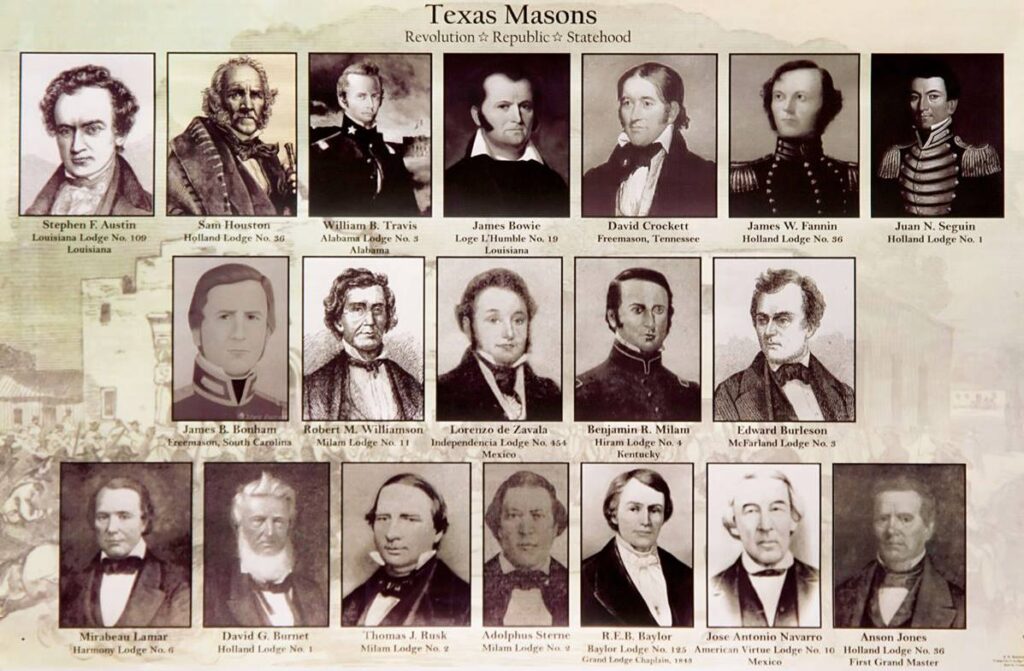
The Texas Rangers were instituted by Masonic Brother Stephen F. Austin and supported and maintained by Masonic Brother Sam Houston, Masonic Brother Mirabeau B. Lamar, and every subsequent President of the Republic of Texas (all Masons); and later, by each Governor of Texas, many of whom were Masons.
Following clashes with the Karankawa Indians, Austin formed two companies of “men. . . to act as rangers for the common defense” and paid for their services himself. The first company was formed in May of 1823 under the command of Moses Morrison and responded to raids along the Texas coast by Tonkawa and Karankawa Indians.
In August 1823, Austin asked for an additional ten men to supplement the Morrison company. These two companies are regarded as the predecessors of the modern Texas Rangers. In 1835 a council of colonial Texas representatives created a “Corps of Rangers” to protect the frontier, formalizing the militia that Austin created.

Stephen F. Austin, a member of Louisiana Lodge No. 111 at Ste. Genevieve, Missouri, sought to establish Freemasonry in Texas. Freemasonry was well established among the educated classes of Mexican society. It had been introduced among the aristocracy loyal to the House of Bourbon, and the conservatives had total control over the Order. By 1827, Americans living in Mexico City had introduced the United States York Rite of Freemasonry as a liberal alternative to the established European-style Scottish Rite.
On February 11, 1828, Austin called a meeting of Freemasons at San Felipe to elect officers and to petition the Masonic Grand Lodge in Mexico City for a charter to form a lodge. Austin was elected Worshipful Master of the new lodge. Although the petition reached Matamoros, and was to be forwarded to Mexico City, nothing more was heard of it. By 1828, the ruling faction in Mexico was afraid the liberal elements in Texas might try to gain their independence. Fully aware of the political philosophies of American Freemasons, the Mexican government outlawed Freemasonry on October 25, 1828. In 1829, Austin called another meeting, where it was decided that it was “impolitic and imprudent, at this time, to form Masonic lodges in Texas.”
BROTHER ANSON JONES

Anson Jones was born on January 20, 1798, in Great Barrington, Massachusetts. Jones was licensed as a doctor by the Oneida, New York, Medical Society, and began medical practice in 1822, and after moving several times, he eventually settled in Philadelphia. He was a member and Past Master of Harmony Masonic Lodge No. 52 of Philadelphia.
He stayed in Philadelphia until going to Venezuela in 1823. Later, Jones returned to Philadelphia, earned an MD, and reopened his practice. He never had much success as a doctor, and in 1832, he renounced medicine and headed for New Orleans, where he entered the mercantile trade. His business efforts never met with any success, and within a year he had no money.
In 1832, Jones headed west to Texas, settling eventually in Brazoria. Here, at last, he met with success, establishing a medical practice that prospered quickly.
In 1835, he began to speak out about the growing tensions between Texas and Mexico, and that year he attended the Consultation, a meeting held at Columbia, by Texas patriots to discuss the fight with Mexico, where he presented a resolution calling for a convention to be held to declare independence, but he himself refused to be nominated to the convention.
Later, in March 1835, Masonic Brothers Anson Jones, John Wharton, Asa Brigham, James Phelps, and Alexander Russell, wishing to formally meet as an organized masonic lodge, met under the Masonic Oak near the burial ground of General John Austin and petitioned the Grand Lodge of Louisiana for dispensation to organize a lodge in the Texas territory.

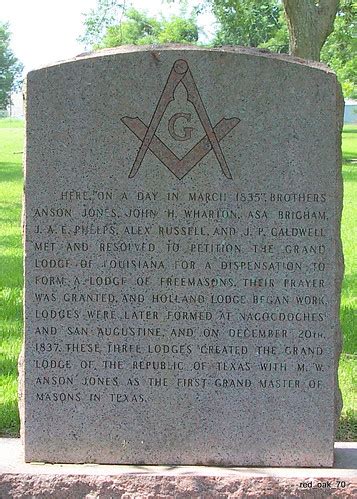
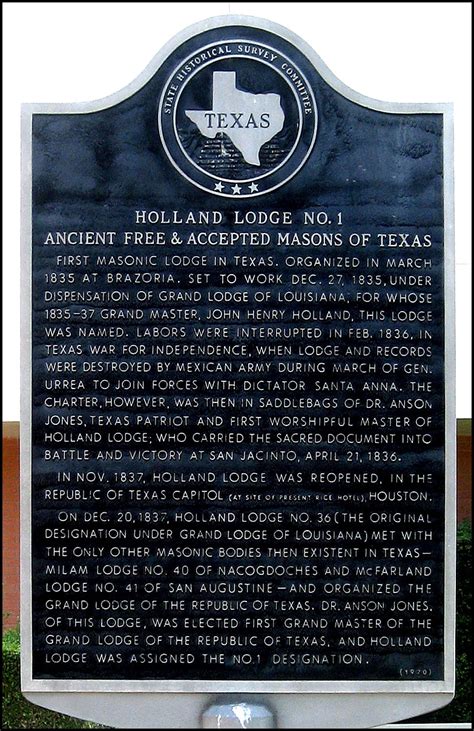
On December 27, 1835, the dispensation was granted by John Holland, Grand Master of Louisiana. Holland Lodge No. 36 of Louisiana was instituted and opened on the second floor of the old courthouse in Brazoria, Texas. Meetings continued here until March 1836, when Brazoria was abandoned due to events related to the Texas Revolution. Holland Lodge is the only Lodge in Texas that has worked under four different flags: The Republic of Mexico, Republic of Texas, Confederate States of America, and The United States.
In December of that year , the lodge was set to labor and Anson Jones was elected its first Master. The charter for Holland Lodge No. 36 arrived during the final days of the revolution, and Jones carried it in his saddlebags during the decisive Battle of San Jacinto on April 21, 1836. At the formation of the Grand Lodge of the Republic of Texas in December 1837, he was elected its first Grand Master. Among the Masons at the time of the Revolution and Republic were Anson Jones, later President of the Republic, Jim Bowie, Davy Crockett, William Barrett Travis, Stephen F. Austin and Sam Houston.
Two more Texas lodges were formed, also given dispensation and charter by the Grand Lodge of Louisiana. They were: Milam Lodge No. 40 in Nacogdoches, and McFarland Lodge No. 41 in San Augustine. Both were formed in 1837. These two lodges, together with Holland Lodge No. 36, sent representatives to meet in Houston and established the Grand Lodge of the Republic of Texas.
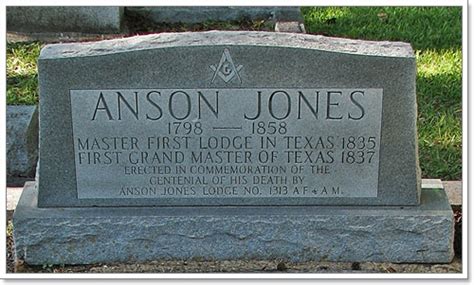
Anson Jones had an extensive and storied career in the founding of Texas and bring organized Freemasonry to the Republic. His life was spent in the service of our Great State. He died in Houston on January January 9, 1858, and was buried in Glenwood Cemetery at Houston. The Texas Centennial Commission erected a statue of him in Anson, Jones County, both of which were named after him. Barrington, his plantation home, is preserved in Washington-on-the-Brazos State Historic Site as part of the Barrington Living History Farm.
THE CIVIL WAR YEARS
In December 1861, the Ninth Texas Legislature authorized the formation of the Frontier Regiment. This unit of Texas Rangers replaced the Confederate First Regiment and Texas Mounted Riflemen at frontier forts.
The Frontier Regiment had three primary goals: defense of the northern and western frontier against Indian and Mexican incursions, defense of the coast against Union invasion, and suppression of crimes.
The financial burden of war began to take its toll on Texas. It cost money to pay and equip Rangers to defend the frontier and support the war effort. The Regiment was organized according to Confederate army regulations and was renamed the Mounted Regiment of Texas State Troops. This was done in the hopes to entice the Confederate government to muster the Regiment into Confederate service. This would shift the payment of troops and supplies from Texas to the Confederate government.
MAJOR JOHN B. JONES AND THE FRONTIER BATTALION
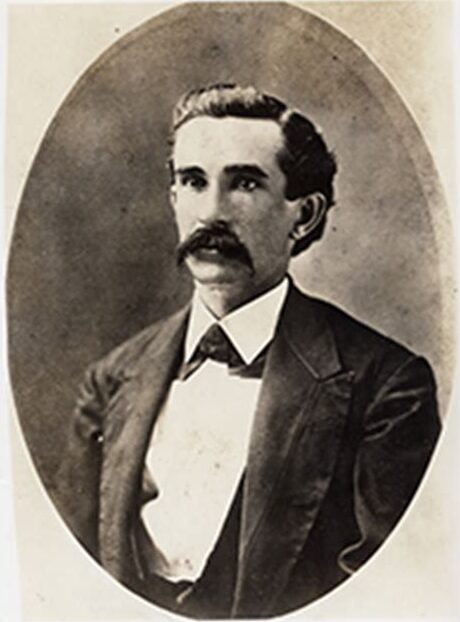
Bloody feuds, lynch mobs, cattle thieves, and killers marked the period following Reconstruction. The abolishment of the State Police and the withdrawal of Federal troops created a noticeable gap in law enforcement. The state’s frontier settlements remained vulnerable to incursions by Native Americans and Mexican bandits. With the end of reconstruction and with tacit approval of the Federal Government, then Gov. Richard Coke established a new force of Texas Rangers, and called it The Frontier Battalion. Coke called upon Brother John B. Jones to head this force, and gave him the rank of Major.
In 1874, when the Texas legislature created the Frontier Battalion, it was the first formal, budgeted organization as an arm of state government of what historically had been periodic groups loosely referred to as Texas Rangers. Initially created to combat the menace of repeated raids of Indians from the north and from Mexico into frontier counties, the Battalion was led by an unusual choice: a frail, humorless Confederate veteran from Navarro County, John B. Jones. Jones was instrumental and even obsessive in the structure and formation of the Regiment, and he set high standards for the men he hired.
In the days when a mans character was often hidden in the last town where he resided, Ranger Jones needed only to know if a man was a Mason. As all Masons are properly vetted and their character vouched for prior to becoming members, it is thought that Masonic Lodge membership was good enough background check. A Texas Ranger that would be hired by Jones must be impeccably honest and trustworthy. They had to be men of faith, capable of charity and compassion. They had to have a sense of duty and justice, for more times than not, those traits were tested daily.

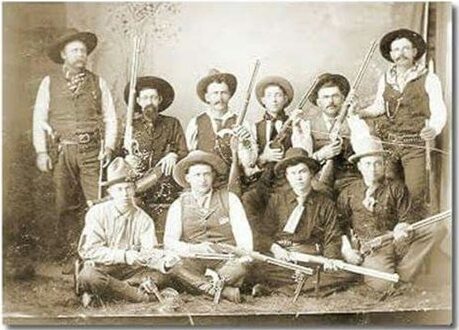
THE JONES OATH
When accepting the job of organizing the Rangers, Jones wrote his own Oath of Office, which has come to be known by Texas Historians as “the Jones Oath”:
“I, John B. Jones, do Solemnly Swear that I will bear true allegiance to the State of Texas, and that I will serve her honestly and faithfully against all her enemies or opposers whatsoever, and observe & obey the orders of the Governor of the State, and the orders of the officers appointed over me according to an Act of the Legislature for raising a Battalion for frontier protection.” Approved April 10, 1874, John B. Jones


According to Wilburn Hill King, the Texas Ranger’ nineteenth-century historian, Jones “had made an excellent record as a man of superior business tact and judgment, and on the battle-field his coolness, quickness of judgment, breadth of comprehension, soldierly skill, and management had marked him as one to trust in time of difficulty.”
BROTHER JONES AS GRAND MASTER OF TEXAS MASONS
During the Masonic year 1879, when Brother Jones was Grand Master, the Grand Lodge of Texas was opened in the usual fashion. Brother Jones then addressed the crowd with an overview of the year’s activities. He announced that twenty new Masonic lodges had been chartered in Texas, yet he felt that the growth of the Masonic Fraternity was not as it should be. He discussed issues facing Texas Masons that year, most of which had to do with individual lodges and membership rules. Some of the topics were general in nature, such as “what to do if one of the brothers hosts a party at the lodge, with gentlemen and ladies present, and causes or incites dancing to take place” (why, it must be stopped!); and “should betting on horse races be prohibited by Grand Lodge” (this issue was not resolved, but it was determined that betting on horse races should not be considered gambling).
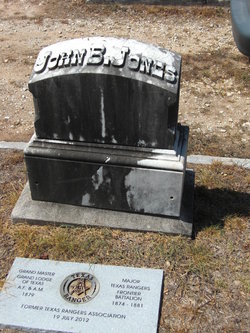
Jones was an active Mason and dedicated to the Craft and to Texas While serving as adjutant general and still commanding the Frontier Battalion, he passed away after “a long and painful illness” Austin on July 19, 1881. He is buried in Oakwood Cemetery there.
No other figure of the Frontier Battalion ever managed to attain the high respect and near reverence that Major Jones did. He was indeed the right man in the right place. He is buried at Oakwood Cemetery in Austin, Texas.
THE MAJOR JOHN B. JONES RANGERING COMPANY

Named after the highest-ranking Texas Ranger during the era of the Frontier Battalion and Past Grand Master of Masons in Texas, the Major John B. Jones Masonic Rangering Company
emphasizes the close relationship that Texas Rangers and Texas Freemasons have always shared.
Recognized in 2010 by article 225a of the Grand Lodge of Texas, membership in the Major John B. Jones Masonic Rangering Company is open to all Masons in good standing with the Grand Lodge of Texas, A.F. & A.M.
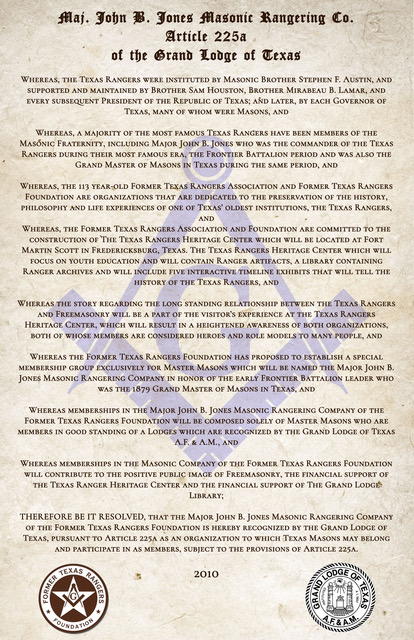
A portion of the fee for each RANGER CAMP will go to the Grand Lodge of Texas Library and Museum, and a portion of it will be allocated to a special Major John B. Jones exhibit in the Texas Rangers Heritage Center. Each Lodge that receives the RANGER CAMP designation will have their Lodge’s name permanently displayed within the Center.

To kick off this new membership program, Rising Star Lodge No. 429, A.F. & A.M., has been granted the designation of RANGER CAMP No. 1.
Long known as “the Ranger Lodge,” Major John B. Jones hired Texas Ranger Captain and Masonic Brother Neal Coldwell to head Co. “F” of the Frontier Battalion, and Bro. Coldwell was instrumental in obtaining the Charter for Rising Star No. 429. He served as WM of the lodge for over 20 years, and four other Worshipful Masters were Texas Rangers, also. Additionally, many of the members served as Rangers, and thus it is fitting that this lodge receive the designation RANGER CAMP No. 1.

PAMPA LODGE No. 966 IS RANGER CAMP No. 22
TEXAS MASONS AND TEXAS RANGERS.
HONOR, INTEGRITY, BRAVERY
BROTHERLY LOVE, RELIEF, AND TRUTH.
SERVING TEXAS FOR 200 YEARS.
MAKING GOOD MEN BETTER SINCE ANCIENT TIMES.
